

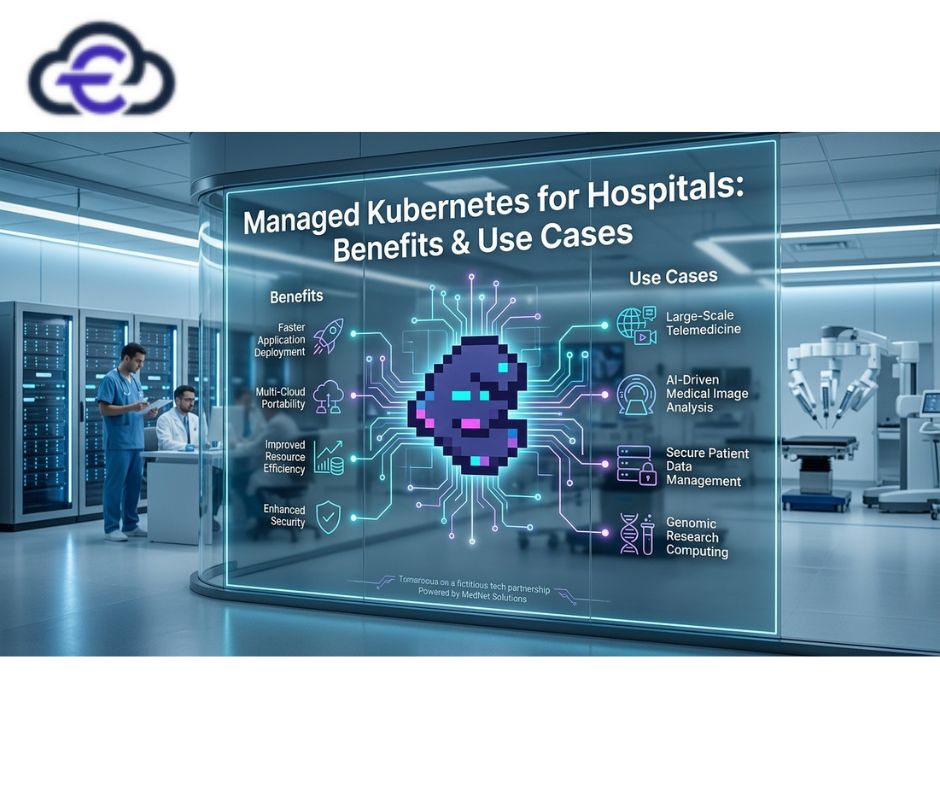
Healthcare organizations are increasingly adopting digital technologies to improve patient care, streamline operations, and manage growing volumes of medical data. Hospitals today rely on electronic health records, telemedicine platforms, medical imaging systems, connected medical devices, patient portals, laboratory applications, pharmacy systems, and many other digital services. As these applications become more complex, hospitals need an IT infrastructure that is secure, scalable, reliable, and easy to manage.
This is where Managed Kubernetes can play an important role.
Managed Kubernetes provides hospitals with a modern platform for deploying, managing, and scaling containerized healthcare applications without requiring their internal IT teams to handle every aspect of Kubernetes infrastructure. It can help healthcare organizations improve application availability, simplify infrastructure management, support digital healthcare services, and respond more efficiently to changing workloads.
What Is Managed Kubernetes?
Kubernetes is an open-source platform used to automate the deployment, scaling, and management of containerized applications. Containers package an application and its dependencies together, making it easier to run applications consistently across different computing environments.
However, managing a Kubernetes environment internally can require specialized knowledge. IT teams may need to manage cluster configuration, updates, security patches, monitoring, networking, storage, backups, and availability.
Managed Kubernetes reduces much of this operational burden. A cloud or infrastructure provider manages important components of the Kubernetes environment, allowing the hospital’s IT team to focus more on applications and healthcare services rather than infrastructure administration.
For hospitals, this can be particularly valuable because healthcare applications often need to remain available around the clock.
1. Supporting Electronic Health Record Applications
Electronic Health Records (EHRs) are central to modern hospital operations. Doctors, nurses, laboratories, pharmacies, billing departments, and administrative teams may depend on healthcare applications to access and update patient information.
Managed Kubernetes can provide a scalable platform for applications that work alongside EHR systems.
For example, hospitals may run applications for:
- Patient registration
- Appointment management
- Doctor dashboards
- Patient portals
- Billing systems
- Laboratory management
- Pharmacy management
- Medical reporting
With Managed Kubernetes, individual application components can run in separate containers. This can make applications easier to deploy, update, and scale.
Hospitals can also allocate resources based on application requirements, helping ensure that critical applications receive sufficient computing resources during periods of high demand.
2. Enabling Telemedicine Services
Telemedicine has become an important part of healthcare delivery. Hospitals may provide video consultations, online appointment systems, remote monitoring, digital prescriptions, and patient communication platforms.
These services can experience significant fluctuations in traffic.
For example, a hospital may have normal traffic during most of the day but experience a sudden increase in online consultations during a health campaign or seasonal illness outbreak.
Managed Kubernetes supports application scaling, allowing additional containers or application instances to be deployed when workloads increase. When demand decreases, resources can be reduced.
This flexibility can help hospitals maintain a reliable telemedicine experience without permanently running infrastructure designed for peak demand.
3. Managing Medical Imaging Applications
Modern hospitals generate large volumes of medical imaging data, including X-rays, CT scans, MRI scans, ultrasound images, and other diagnostic information.
Applications that process, store, transfer, or analyze medical images can require significant computing resources.
Managed Kubernetes can support containerized imaging-related applications and processing workloads. Hospitals can use Kubernetes to organize different application components and scale processing workloads when necessary.
For example, a hospital could run separate services for image processing, reporting, authentication, and communication with other healthcare systems.
This approach can make complex healthcare applications easier to manage and update.
4. Supporting AI and Machine Learning in Healthcare
Artificial intelligence is increasingly being explored for medical imaging, clinical decision support, predictive analytics, patient monitoring, drug discovery, and operational optimization.
AI workloads can require significant computing power, particularly when processing large datasets or running machine learning models.
Managed Kubernetes can provide an environment for deploying AI and machine learning applications using containers. Hospitals and healthcare technology providers can deploy different AI services independently and scale computing resources according to workload requirements.
For example, an AI application used for medical image analysis may require significantly more computing resources during peak processing periods than during normal operations.
Kubernetes-based infrastructure can help manage these changing requirements.
However, hospitals must ensure that AI applications are appropriately validated and comply with applicable healthcare, privacy, security, and regulatory requirements.
5. Connecting IoT and Medical Devices
Hospitals increasingly use connected devices such as patient monitors, infusion pumps, wearable devices, smart beds, diagnostic equipment, and other Internet of Things (IoT) technologies.
These devices can generate large amounts of data.
Managed Kubernetes can support backend services that collect, process, and analyze information from connected medical devices.
For example, data from patient monitoring devices could be sent to a healthcare application where it is processed and displayed to authorized medical professionals.
A Kubernetes-based architecture can separate different services, such as data collection, processing, alerts, analytics, and dashboards.
This can make the overall system more modular and easier to maintain.
6. Improving Application Scalability
Hospital workloads are not always predictable.
A hospital may experience sudden increases in demand because of emergencies, seasonal diseases, public health events, or the introduction of a new digital service.
Traditional infrastructure may require organizations to provision enough capacity in advance to handle peak workloads. This can result in unused resources during normal periods.
Managed Kubernetes enables organizations to design applications that can scale according to demand.
For example, if a patient portal receives a large increase in traffic, additional application instances can be deployed to handle the workload.
This scalability can help hospitals provide a consistent digital experience while making more efficient use of infrastructure resources.
7. Supporting High Availability
Healthcare applications can be business-critical. An outage affecting appointment systems, patient portals, laboratory applications, or communication platforms can disrupt hospital operations.
Managed Kubernetes can support high-availability architectures by distributing application workloads across multiple containers and infrastructure resources.
If one application instance becomes unavailable, another instance may continue serving requests, depending on how the application and Kubernetes environment are designed.
Hospitals can also implement monitoring, automated recovery, load balancing, and redundancy strategies.
High availability should be designed according to the criticality of each healthcare application rather than assuming that Kubernetes alone guarantees uninterrupted service.
8. Strengthening Security and Access Control
Healthcare data is highly sensitive. Patient information, medical records, diagnostic reports, and financial information must be protected against unauthorized access.
Managed Kubernetes can provide security features such as role-based access control, network policies, secrets management, workload isolation, and controlled access to applications.
Hospitals can also integrate Kubernetes workloads with identity and access management systems.
Security should be implemented at multiple levels, including:
- Container security
- Network security
- Application security
- Identity management
- Data encryption
- Vulnerability scanning
- Monitoring and logging
- Backup and disaster recovery
A Managed Kubernetes provider may handle certain infrastructure-level security responsibilities, but the hospital remains responsible for securing its applications, data, configurations, and access policies according to the provider’s shared-responsibility model.
9. Disaster Recovery and Business Continuity
Hospitals need reliable disaster recovery strategies because technology failures can affect essential operations.
Managed Kubernetes can be incorporated into disaster recovery architectures by using replicated infrastructure, application backups, persistent storage strategies, and automated deployment processes.
Containerized applications can also be redeployed consistently in another environment when the required infrastructure and data are available.
Hospitals should establish recovery objectives based on application criticality, including Recovery Time Objectives (RTO) and Recovery Point Objectives (RPO).
A well-designed disaster recovery strategy can help healthcare organizations recover applications more efficiently after infrastructure failures or other disruptions.
10. Faster Application Development and Deployment
Healthcare organizations frequently introduce new digital services. These may include patient mobile applications, online booking systems, digital payment services, remote consultation platforms, or internal dashboards.
Managed Kubernetes can support DevOps and CI/CD practices, allowing development teams to build, test, and deploy applications in a more standardized environment.
Developers can package applications into containers and deploy them through controlled pipelines.
This can reduce manual deployment processes and make application updates more consistent.
For hospitals working with internal development teams or healthcare software providers, this can accelerate the delivery of new digital services.
11. Cost and Resource Optimization
Running healthcare applications on traditional infrastructure can require significant investment in servers, networking equipment, storage, maintenance, and specialized IT personnel.
Managed Kubernetes can shift some infrastructure management responsibilities to a cloud or technology provider.
Hospitals can potentially reduce the operational effort required to manage Kubernetes infrastructure while using resources more dynamically.
However, Kubernetes does not automatically reduce costs. Poorly configured clusters, unnecessary workloads, excessive storage, or over-provisioning can increase expenses.
Hospitals should therefore monitor resource utilization and establish appropriate cost-management policies.
12. Simplifying IT Operations
Healthcare IT environments can become complicated as organizations add new applications, devices, databases, and digital services.
Managing every Kubernetes component internally can place additional pressure on IT teams.
Managed Kubernetes allows the provider to take responsibility for many infrastructure management tasks, depending on the service model.
This can allow hospital IT professionals to spend more time on application performance, healthcare workflows, data integration, cybersecurity, and user experience.
What Should Hospitals Consider Before Adopting Managed Kubernetes?
Although Managed Kubernetes offers significant advantages, hospitals should carefully evaluate their requirements before implementation.
Data Privacy and Compliance
Hospitals should understand where healthcare data is stored, processed, and transferred. The selected infrastructure should support the applicable healthcare privacy and data protection requirements in the hospital’s jurisdiction.
Security
Security controls should cover the entire environment, including containers, APIs, networks, databases, identities, and storage.
Integration
The Kubernetes environment should integrate effectively with existing healthcare systems, databases, EHR platforms, laboratory systems, imaging systems, and other applications.
Reliability
Hospitals should evaluate availability, backup, monitoring, disaster recovery, and support capabilities before selecting a Managed Kubernetes provider.
Technical Expertise
Although Managed Kubernetes reduces infrastructure administration, hospitals still need professionals who understand containers, cloud architecture, application security, networking, monitoring, and DevOps.
The Future of Managed Kubernetes in Healthcare
Healthcare is becoming increasingly digital. As hospitals adopt telemedicine, AI, connected medical devices, patient applications, digital health platforms, and data-driven services, their IT environments will continue to grow in complexity.
Managed Kubernetes provides a flexible foundation for running many of these modern applications.
Instead of managing every infrastructure component manually, hospitals can use a managed platform to deploy containerized applications, scale workloads, improve operational efficiency, and support high-availability architectures.
The key is to implement Kubernetes as part of a broader healthcare IT strategy that includes security, compliance, data protection, monitoring, backup, disaster recovery, and strong governance.
Conclusion
Managed Kubernetes can help hospitals build a scalable, reliable, and modern application infrastructure for digital healthcare services. From EHR-related applications and telemedicine platforms to medical imaging, AI, IoT devices, and patient portals, Kubernetes can support a wide range of healthcare workloads.
By choosing a Managed Kubernetes approach, hospitals can reduce the operational burden of managing Kubernetes infrastructure while giving their IT and development teams a platform for building and scaling modern applications.
For healthcare organizations planning their next stage of digital transformation, Managed Kubernetes can be an important component of a secure, flexible, and future-ready IT infrastructure.

