

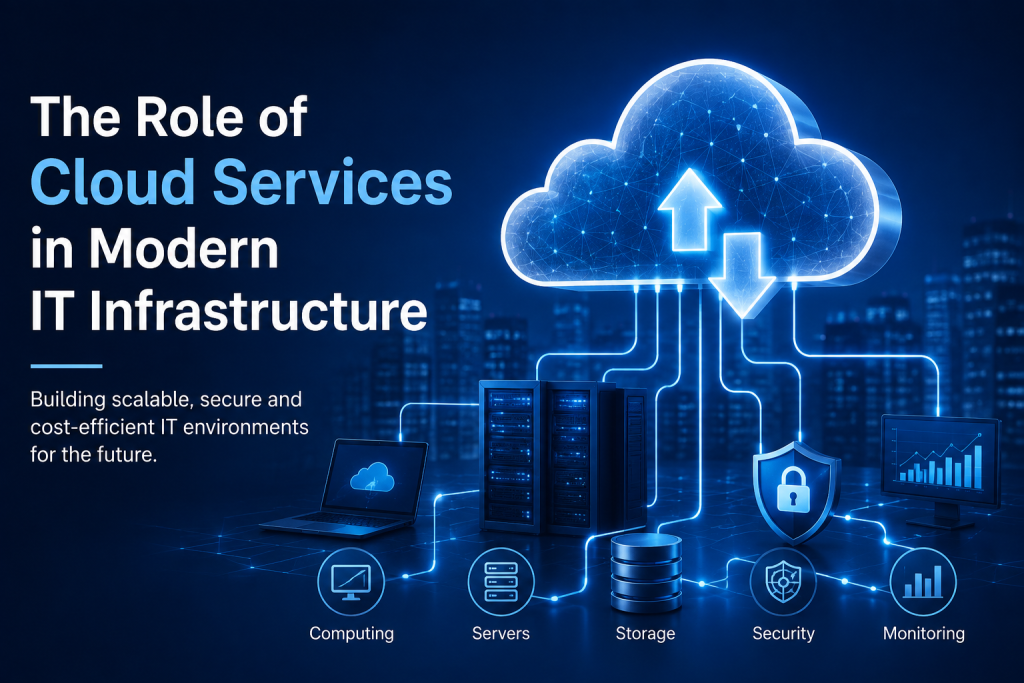
Modern businesses depend on technology to operate efficiently, serve customers, manage data, and stay competitive. As business requirements continue to change, traditional IT infrastructure can become expensive, difficult to scale, and challenging to manage. This is where cloud services have become an important part of modern IT infrastructure.
Cloud services provide businesses with access to computing resources such as servers, storage, databases, networking, security, applications, and monitoring through the internet. Instead of relying entirely on physical infrastructure, organizations can use flexible cloud environments that can adapt to their changing requirements.
What Are Cloud Services?
Cloud services are IT resources and applications delivered over the internet by cloud service providers. Businesses can access these resources without having to purchase and maintain all the required physical hardware themselves.
Depending on their requirements, organizations can use cloud services for:
- Cloud computing and virtual servers
- Data storage and backup
- Database management
- Network management
- Application hosting
- Cloud security
- Disaster recovery
- Cloud monitoring
- Kubernetes and container management
- Business continuity
- Cloud migration and optimization
This flexibility allows businesses to build IT infrastructure according to their specific operational and technical needs.
Why Are Cloud Services Important for Modern IT Infrastructure?
Modern IT infrastructure needs to be flexible, secure, scalable, and cost-efficient. Cloud services can help organizations achieve these objectives while reducing their dependence on physical infrastructure.
1. Improved Scalability
Business requirements can change quickly. A company may need additional computing power during periods of high demand and fewer resources during slower periods.
Cloud services allow businesses to increase or decrease resources based on demand. This scalability helps organizations avoid investing heavily in infrastructure that may remain underutilized.
For example, an e-commerce business may require additional computing resources during a major sales event. Cloud infrastructure can be scaled to handle increased traffic and then adjusted when demand returns to normal.
2. Reduced IT Infrastructure Costs
Maintaining physical servers and data centers can involve significant expenses, including hardware purchases, maintenance, electricity, cooling, upgrades, and technical support.
With cloud services, businesses can access infrastructure without necessarily owning and maintaining all the underlying hardware. Depending on the cloud model and usage, organizations can adopt more flexible consumption-based approaches.
This can make cloud infrastructure particularly useful for startups and growing businesses that want to expand without making large upfront infrastructure investments.
3. Better Business Flexibility
Modern businesses need to respond quickly to changing markets and customer expectations. Cloud services provide organizations with the flexibility to deploy applications, storage, and computing resources more quickly.
Development teams can create and test applications in cloud environments without waiting for physical hardware to be installed and configured.
This can shorten deployment cycles and help businesses bring new products and services to market faster.
4. Enhanced Data Storage and Accessibility
Data is one of the most valuable assets for modern businesses. Organizations need reliable ways to store, manage, access, and protect their information.
Cloud storage allows businesses to store data in scalable environments and access it from authorized locations and devices.
Cloud-based storage can also support:
- Automated backups
- Data replication
- Disaster recovery
- File sharing
- Centralized data management
- Business collaboration
With the right security controls and policies, businesses can make important data accessible to authorized users while maintaining appropriate protection.
5. Support for Remote and Hybrid Work
Remote and hybrid working have changed the way organizations manage IT infrastructure.
Employees may need access to business applications and data from different locations. Cloud services can support this model by providing centralized access to applications, collaboration platforms, storage, and other business resources.
This enables organizations to build IT environments that are less dependent on employees working from a particular physical location.
6. Stronger Disaster Recovery and Business Continuity
Unexpected events such as hardware failures, cyber incidents, natural disasters, or network disruptions can affect business operations.
Cloud services can play an important role in disaster recovery strategies by providing options for data backup, replication, recovery environments, and redundant infrastructure.
A well-designed cloud disaster recovery strategy can help organizations restore critical systems and reduce potential downtime.
However, simply moving workloads to the cloud does not automatically guarantee disaster recovery. Businesses need appropriate backup policies, recovery objectives, security controls, and testing procedures.
7. Improved Cloud Security
Security is a major consideration when designing modern IT infrastructure.
Cloud service providers typically offer a range of security capabilities, including identity and access management, encryption, network security, monitoring, logging, and threat detection.
However, cloud security is a shared responsibility. Businesses must also properly configure their environments, manage user permissions, protect credentials, monitor systems, and establish security policies.
Using cloud services effectively therefore requires both technology and appropriate security practices.
8. Easier IT Management
Managing physical infrastructure can require significant time and technical resources. Cloud services can simplify many infrastructure management tasks.
Businesses can use centralized tools to manage computing resources, storage, networking, monitoring, and applications.
Automation can further reduce repetitive manual tasks. Organizations can automate processes such as resource deployment, backups, monitoring alerts, and infrastructure provisioning.
This allows IT teams to focus more on strategic initiatives rather than spending all their time maintaining infrastructure.
9. Support for Digital Transformation
Digital transformation requires businesses to adopt technologies that can support innovation and operational efficiency.
Cloud services provide a foundation for technologies such as:
- Artificial intelligence
- Machine learning
- Big data analytics
- Internet of Things
- Containers
- Kubernetes
- DevOps
- Serverless computing
- Advanced databases
Because cloud environments can provide access to these technologies without requiring organizations to build everything from scratch, businesses can experiment with new solutions more efficiently.
10. Multi-Cloud and Hybrid Cloud Infrastructure
Not every business has the same infrastructure requirements. Some organizations may use public cloud environments, while others may need private infrastructure or a combination of both.
Hybrid cloud infrastructure combines private and public environments, allowing businesses to place workloads according to their security, performance, compliance, and operational requirements.
A multi-cloud strategy involves using services from multiple cloud providers. This approach can provide flexibility but also introduces additional management and security complexity.
Businesses should therefore select their cloud strategy based on their actual requirements rather than adopting multiple platforms simply because they are available.
How Cloud Services Are Changing Traditional IT Infrastructure
Traditional IT infrastructure often relies heavily on physical servers, on-premises storage, and manually managed systems.
Modern infrastructure increasingly uses virtualized and cloud-based resources. This shift changes the role of IT teams from primarily maintaining hardware to managing services, applications, security, automation, data, and overall infrastructure performance.
For example, instead of purchasing a physical server for every new application, an organization can provision cloud resources according to workload requirements.
This creates a more flexible infrastructure model that can evolve alongside the business.
Choosing the Right Cloud Services
Selecting the right cloud solution requires careful planning. Businesses should consider several factors before moving workloads to the cloud.
Business Requirements
Organizations should identify why they want to adopt cloud technology. Common objectives include reducing infrastructure costs, improving scalability, supporting remote work, increasing availability, or modernizing applications.
Security Requirements
Businesses should evaluate data protection, identity management, encryption, access controls, compliance requirements, and monitoring capabilities.
Performance
Applications with demanding workloads may require specific computing, networking, storage, or database capabilities. Performance requirements should be assessed before selecting a cloud architecture.
Cost Management
Cloud infrastructure can provide cost flexibility, but uncontrolled usage can also increase expenses. Organizations should implement monitoring, budgeting, resource optimization, and appropriate governance.
Migration Strategy
Moving existing applications to the cloud requires careful planning. Businesses should determine which workloads should be migrated, modernized, replaced, or retained on existing infrastructure.
The Future of Cloud-Based IT Infrastructure
Cloud technology will continue to influence how businesses design and manage IT infrastructure. Automation, artificial intelligence, containerization, edge computing, serverless technologies, and multi-cloud environments are expected to play increasingly important roles.
As organizations become more dependent on digital systems, the ability to create scalable, secure, and resilient infrastructure will become even more important.
Cloud services can provide the foundation for this transformation, but successful adoption requires proper architecture, governance, security, monitoring, and ongoing optimization.
Conclusion
Cloud services have become an important component of modern IT infrastructure. They can help businesses improve scalability, reduce infrastructure complexity, support remote work, strengthen disaster recovery, enhance operational flexibility, and accelerate digital transformation.
However, adopting cloud technology should not simply mean moving existing systems to a cloud platform without a strategy. Businesses should evaluate their workloads, security requirements, performance needs, costs, and long-term objectives before designing their cloud environment.
With the right strategy and management approach, cloud services can help organizations build a more flexible, scalable, secure, and future-ready IT infrastructure.

