

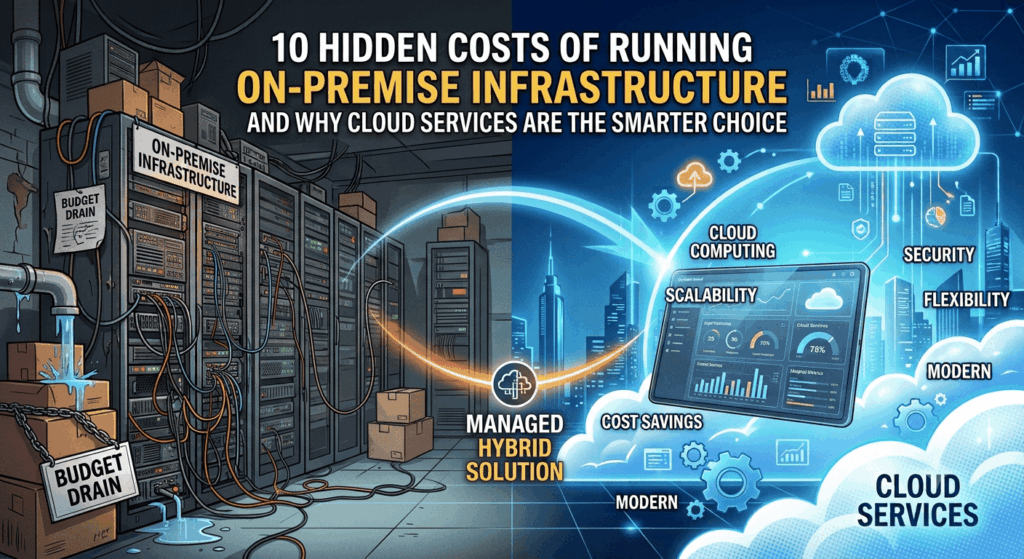
As technology evolves, companies are realizing that maintaining physical servers is becoming increasingly expensive and inefficient. Unexpected downtime, hardware failures, rising electricity bills, security concerns, and limited scalability are just a few of the challenges organizations face.
This is where cloud services are transforming modern businesses. Instead of investing heavily in physical infrastructure, organizations can leverage cloud services to reduce operational costs, improve performance, enhance security, and ensure business continuity.
In this blog, we’ll uncover the 10 hidden costs of running on-premise infrastructure and explain why adopting cloud services is a smarter long-term investment.
Understanding the True Cost of On-Premise Infrastructure
Many businesses believe buying servers is a one-time investment. In reality, the purchase cost is only the beginning.
Beyond hardware, organizations must account for:
- Infrastructure maintenance
- Software licensing
- Data center operations
- IT staffing
- Power consumption
- Cooling systems
- Security upgrades
- Backup systems
- Disaster recovery planning
- Equipment replacement
These ongoing expenses accumulate year after year, making traditional infrastructure far more expensive than initially expected. This is one reason why businesses are increasingly choosing cloud services to simplify IT management while reducing costs.
Expensive Hardware Refresh Cycles
Servers, storage devices, and networking equipment have a limited lifespan.
Typically, businesses replace hardware every 3–5 years. This includes:
- New servers
- Storage upgrades
- Networking devices
- Backup hardware
- Firewalls
The capital expenditure required for regular upgrades can significantly impact budgets.
With cloud services, infrastructure is managed by the cloud provider, eliminating costly hardware replacement cycles while ensuring businesses always access the latest technology.
Rising Maintenance and Support Costs
Maintaining on-premise infrastructure requires continuous investment.
Common maintenance costs include:
- Annual maintenance contracts
- Hardware repairs
- Software updates
- Security patching
- Vendor support
Unexpected hardware failures can also cause emergency expenses.
Using cloud services, maintenance responsibilities shift to the provider, allowing internal IT teams to focus on innovation instead of infrastructure management.
Limited Scalability Slows Business Growth
Business demands constantly change.
An on-premise environment requires purchasing additional hardware before growth occurs.
This often results in:
- Overprovisioning
- Underutilized resources
- Delayed expansion
- Long procurement cycles
In contrast, cloud services provide instant scalability, enabling businesses to increase or decrease computing resources within minutes.
This flexibility supports seasonal demand, business growth, and digital transformation without significant upfront investment.
High Energy and Cooling Expenses
Running a server room consumes substantial electricity.
Organizations must pay for:
- Server power
- Air conditioning
- Cooling systems
- UPS equipment
- Generator maintenance
Energy costs continue to rise every year.
By adopting cloud services, businesses eliminate these operational expenses because the cloud provider manages energy-efficient data centers.
Downtime Costs More Than You Think
Unexpected outages can have severe financial consequences.
Downtime leads to:
- Lost revenue
- Reduced productivity
- Customer dissatisfaction
- Missed business opportunities
- Brand reputation damage
Traditional infrastructure often relies on limited redundancy.
Modern cloud services offer high availability through geographically distributed infrastructure and automated failover capabilities, minimizing business disruption.
Security Investments Never Stop
Cybersecurity threats continue to evolve.
Organizations running on-premise environments must invest in:
- Firewalls
- Endpoint protection
- Intrusion detection
- Security monitoring
- Compliance tools
- Vulnerability management
These expenses increase every year.
Leading cloud services providers continuously invest in advanced security technologies, offering enterprise-grade protection that many businesses cannot afford independently.
Disaster Recovery Is Expensive
Many organizations underestimate disaster recovery costs.
A comprehensive disaster recovery strategy requires:
- Secondary data centers
- Backup infrastructure
- Replication software
- Network redundancy
- Regular testing
Without proper disaster recovery, businesses risk losing critical data during unexpected events.
Cloud services simplify disaster recovery by offering automated backups, cross-region replication, and rapid recovery options that reduce downtime and protect business operations.
IT Teams Spend Too Much Time Managing Infrastructure
Highly skilled IT professionals often spend most of their time on routine infrastructure tasks.
These include:
- Server monitoring
- Hardware maintenance
- Software updates
- Capacity planning
- Backup management
Instead of focusing on innovation, automation, or business improvements, teams remain occupied with maintaining legacy systems.
With cloud services, infrastructure management becomes automated, enabling IT professionals to concentrate on strategic initiatives.
Software Licensing Becomes More Complex
Traditional infrastructure requires purchasing and managing numerous licenses.
Examples include:
- Operating systems
- Database software
- Backup software
- Virtualization platforms
- Security tools
Licensing costs often increase as infrastructure grows.
Many cloud services include flexible licensing models or pay-as-you-go pricing, allowing businesses to optimize software spending.
Lack of Business Agility
Modern businesses must respond quickly to changing market conditions.
Launching new applications using on-premise infrastructure may require:
- Purchasing hardware
- Installing servers
- Configuring networks
- Testing environments
This process can take weeks or months.
With cloud services, organizations can deploy applications within minutes, enabling faster innovation and improved customer experiences.
Business Value of Cloud Services
Moving to cloud services provides more than cost savings—it creates measurable business value.
Faster Innovation
Businesses can launch products quickly without waiting for infrastructure procurement.
Improved Operational Efficiency
Automation reduces repetitive tasks and improves resource utilization.
Better Employee Productivity
Teams can securely access applications from anywhere, supporting hybrid and remote work models.
Increased Reliability
Enterprise-grade infrastructure ensures high availability and consistent performance.
Global Reach
Applications can be deployed closer to customers across multiple regions.
These advantages help organizations remain competitive while reducing operational complexity.
Common Challenges Businesses Face Before Moving to the Cloud Services
Although the benefits are significant, organizations often hesitate due to concerns such as:
- Migration complexity
- Data security
- Compliance requirements
- Downtime during migration
- Legacy application compatibility
- Cost visibility
- Skills gaps
Working with experienced cloud experts simplifies migration planning, minimizes risks, and ensures a smooth transition.
How Cloud Services Solve These Challenges
Modern cloud services address nearly every limitation associated with traditional infrastructure.
Key capabilities include:
- Elastic scalability
- Built-in security
- Continuous monitoring
- Automated backups
- Disaster recovery
- High availability
- Pay-as-you-go pricing
- Centralized management
- Global infrastructure
- Performance optimization
Instead of managing infrastructure, businesses can focus on delivering value to customers.
Scalability Without Capital Investment
One of the greatest advantages of cloud services is the ability to scale instantly without purchasing additional hardware. Businesses only pay for the resources they use, making growth more predictable and financially efficient.
Built-In Security and Compliance
Leading cloud services providers implement advanced encryption, identity management, continuous monitoring, and compliance certifications. This helps organizations strengthen security while reducing the burden on internal IT teams.
Cost Optimization Through Pay-As-You-Go Pricing
Unlike traditional infrastructure that requires large upfront investments, cloud services offer flexible pricing models. Organizations can optimize costs by scaling resources up or down based on actual business needs, eliminating unnecessary spending on idle infrastructure.
Why Businesses Choose Evren Cloud
At Evren Cloud, we help organizations modernize their IT infrastructure with secure, scalable, and fully managed cloud solutions. Whether you’re planning your first cloud migration or optimizing an existing environment, our team delivers tailored cloud services that reduce operational costs, improve performance, strengthen security, and ensure business continuity.
Our expertise includes Public Cloud, Private Cloud, Hybrid Cloud, Cloud Migration, Kubernetes as a Service, Database Management, Cloud Security, Disaster Recovery, Cloud Optimization, Monitoring, and Always-On Cloud Operations. We work closely with businesses to create cloud strategies that align with their goals while maximizing return on investment.
Conclusion
The hidden costs of maintaining on-premise infrastructure extend far beyond hardware purchases. From maintenance and energy consumption to security, disaster recovery, scalability, and operational inefficiencies, traditional environments can significantly limit business growth and increase long-term expenses.
By adopting cloud services, organizations gain greater flexibility, stronger security, improved availability, faster deployment, and predictable costs. More importantly, they free their teams from infrastructure management so they can focus on innovation and delivering value to customers.
As businesses continue their digital transformation journey, investing in cloud services is no longer just a technology decision—it’s a strategic business decision that drives efficiency, resilience, and sustainable growth.

